What Maintenance Backlogs Actually Reveal About Your Operation

.jpeg)
Most maintenance organizations have a backlog. That's not unusual, and it isn't necessarily a problem.
The more important question is why work continues accumulating.
Are emergency repairs consuming time that was intended for preventive maintenance?
Are jobs sitting open because of planning issues, staffing constraints or unclear priorities?
… or is the backlog reflecting larger operational challenges that haven't yet been addressed?
Organizations that consistently improve maintenance performance use backlog data to understand why work is accumulating in the first place rather than simply focusing on completing more work orders.
What Is a Maintenance Backlog?
A maintenance backlog is often viewed as a list of unfinished work, but it's more useful to think of it as work that's waiting for the right time, resources or priority to be completed.
That work may include:
- Preventive maintenance
- Corrective repairs
- Inspections
- Equipment upgrades
- Other planned work that has been identified but remains outstanding
A certain amount of backlog is both normal and necessary. Every maintenance organization has more work that could be completed than can realistically be accomplished at any given time.
The challenge isn't having a backlog. It's understanding why it exists.
Viewed through that lens, a maintenance backlog acts as an operational indicator that offers valuable insight into how effectively a maintenance program is functioning and where opportunities for improvement may exist.
Why Do Maintenance Backlogs Grow?
Maintenance backlogs rarely develop because technicians aren't working hard enough.
In Pro's experience, growing backlogs are usually the result of broader operational challenges that limit an organization's ability to execute planned work consistently.
Some of the most common contributors include:
- Excessive reactive maintenance that continually interrupts planned work
- Poor planning and scheduling that delays execution
- Preventive maintenance programs that fail to prevent recurring failures
- Workforce shortages or technical skill gaps
- Production demands that consistently take priority over maintenance activities
- Delays in obtaining replacement parts or critical materials
- Unclear asset priorities that make work difficult to sequence effectively
In many facilities, the cycle looks something like this:
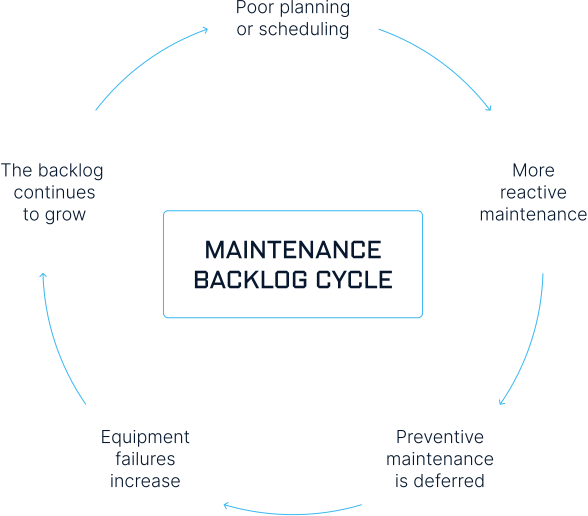
As the cycle continues, the backlog becomes a reflection of these underlying operational patterns — not the problem itself, but evidence of the conditions that continue to create more work than the organization can complete.
What Your Maintenance Backlog May Be Telling You
Not all backlogs tell the same story. Looking beyond the total number of work orders can help you identify the systemic issues that are creating (and sustaining) the backlog.
Reactive Work Is Crowding Out Planned Work
One of the clearest indicators of an unhealthy maintenance program is when emergency work consistently interrupts scheduled activities.
Preventive maintenance, inspections and planned repairs are repeatedly delayed because technicians are responding to unexpected equipment failures. While restoring production is often necessary, this cycle becomes difficult to escape. The more reactive work increases, the less time remains for planned maintenance that could prevent future failures.
A backlog dominated by deferred preventive maintenance is often a sign that reactive work has become the organization's default operating mode.
Preventive Maintenance May Not Be Working
A backlog can also reveal whether preventive maintenance is actually preventing failures or adding work to the schedule.
If the same assets repeatedly generate corrective work orders despite routine maintenance, the issue may lie in the maintenance strategy itself. The work being performed may not address the conditions that are actually causing failures.
In these cases, improving preventive maintenance is less about doing more work and more about doing the right work.
Planning and Scheduling Need Improvement
Not every overdue work order is the result of limited labor.
Jobs may remain open because parts haven't arrived, work instructions are incomplete, permits are unavailable or production schedules haven't been coordinated. Each delay slows execution and makes it more difficult to keep planned work on schedule.
That's why backlog age often tells a more meaningful story than its size. When work orders remain open for weeks or months, they often point to breakdowns in the planning process rather than the execution itself.
Resources Aren't Matching Workload
Maintenance demand changes over time because new equipment, aging assets, expanding production and increasing operational complexity all increase the amount of work required to support production performance.
If staffing levels, technical capabilities or contractor support don't keep pace, backlog becomes increasingly difficult to control.
Rather than indicating poor individual performance, this type of backlog signals a mismatch between available resources and the amount of work required to maintain reliability.
Priorities May Not Be Clearly Defined
When everything is treated as urgent, nothing is truly prioritized.
Without a clear understanding of asset criticality and business impact, maintenance teams often struggle to prioritize work effectively, causing high-priority repairs to compete with routine requests.
In these cases, the backlog becomes driven by the loudest problem rather than the most important one.
How to Use Maintenance Backlog Data to Improve Reliability
Looking beyond the total number of open work orders often reveals a much clearer picture. While the total number of open work orders provides useful context, it rarely tells the whole story. The real value comes from the patterns within the backlog, not the amount of work it contains.
When work begins aging, the consequences extend beyond the backlog itself. The longer critical work remains unresolved, the greater the risk of equipment failure and unplanned downtime.
To identify these patterns, leading maintenance organizations start with monitoring six metrics:
1. Aging work orders
2. Planned versus reactive maintenance
3. Repeat work on the same assets
4. Preventive maintenance completion rates
5. Asset-specific maintenance trends
6. Labor utilization and available capacity
Viewed together, these metrics help maintenance leaders move beyond reacting to today's workload and begin addressing the conditions that create tomorrow's.
Pro Services Helps Manufacturers Build More Reliable Maintenance Programs
A growing maintenance backlog isn't a problem to hide or simply work through. It's an opportunity to better understand what's holding your maintenance program back.
The organizations that improve reliability don't get there by asking their teams to work faster. They strengthen the fundamentals behind maintenance execution, from planning and scheduling to preventive maintenance, work prioritization and workforce capability.
That's where Pro Services comes in.
Through Pro Workforce Solutions and Maintenance Improvement Programs, we help manufacturers identify the underlying issues driving backlog growth and build maintenance programs that execute work more consistently, reduce reactive maintenance and support more predictable production.
Ready to identify what's driving recurring backlog growth? Partner with Pro to schedule a maintenance assessment and start building a more reliable operation.
Field Notes
Building a Stronger, Safer Team – Our First Annual Safety Day
Pro Services Expansion: 250 New Jobs Coming to Michigan
All other trademarks are owned by their respective companies.