2026 State of Maintenance Report
Participation from 55 Maintenance Leaders
The respondents represent organizations of varying sizes and industries, with participation from operations, maintenance and executive leadership.
This report is designed for maintenance, operations and corporate leaders within the manufacturing sector who want to benchmark their operations, build stronger business cases for leadership and guide their teams from reactive to proactive maintenance workflows.
The 2026 State of Maintenance Report by Pro Services explores the most persistent maintenance challenges facing today’s manufacturing leaders. The report is structured around Seven Key Decisions that influence long-term maintenance performance and maturity:
- Baseline Maintenance Performance
- Operational Fundamentals
- Workforce Risks
- Technology Readiness
- Organizational Support
- Measuring Progress
- Future Readiness

If you've ever looked at your maintenance backlog and wondered why the same problems continue to return despite your team's best efforts, you're asking the same question as maintenance leaders across the industry.
No maintenance organization expects to eliminate every equipment failure or unplanned repair. But when the same assets continue to fail, reactive work consistently displaces planned work and familiar challenges surface year after year, it's a sign that something more than individual breakdowns is at play.
Drawing on research conducted with 55 manufacturing leaders, the Pro Services State of Maintenance Report examines why recurring maintenance problems persist — and what organizations that consistently improve reliability do differently.

Recurring Problems Rarely Have a Single Cause
You may recognize some of these challenges:
- The same equipment continues to fail even after repeated repairs, disrupting production and frustrating both maintenance teams and the operators who depend on it
- Preventive maintenance is often deferred because reactive work takes priority
- Critical maintenance knowledge is held by only a handful of experienced employees, making it difficult to standardize processes or prepare for retirements
- Technology investments haven't delivered the operational improvements you expected, despite significant time and effort
- Your team works hard every day, yet it still feels like you're responding to the same issues instead of moving beyond them
See what the research reveals about why these challenges persist and what maintenance teams can do about them.
Pro Services Safety Specialist


Seven Decisions that Drive Maintenance Performance
Download the ReportThis report is organized around seven decisions that consistently influence long-term maintenance performance, not individual statistics or isolated maintenance trends.
Each decision addresses a foundational aspect of maintenance maturity. Together, they provide a practical framework for understanding why recurring problems develop, where organizations should focus their improvement efforts and how lasting performance is built over time.
As you read, consider how these findings compare to your own operation and where your greatest opportunities for improvement may lie.
The Seven Key Decisions
Every maintenance organization faces these seven key decisions. The challenge isn't whether or not they need to be addressed. They all do. Rather, it's understanding which ones will have the greatest impact on your operation and how they build on one another.
Most importantly, the research suggests that the order in which these decisions are made is just as important as the decisions themselves.
The next step is understanding where your own organization stands.
Take the Maturity Model AssessmentHow well do you understand your maintenance performance?
"I'd change our approach to be plan-driven instead of reaction-based. We have many resources working on different aspects of maintenance, but it's not clear how the initiatives feed into one greater strategy."
— Director of Operations, Consumer Goods/Packaging
You can’t improve what you can’t see
Better maintenance decisions start with a clear understanding of current performance. Without it, it's difficult to know which problems deserve your attention first or whether your improvement efforts are making a difference.
Organizations with a clear picture of their maintenance performance scored nearly 20% higher in work execution than those without it. The research also found that organizations with the strongest results consistently had the fundamentals in place, including planning, workforce development and preventive maintenance compliance.
Even still, nearly half of the organizations in this study couldn't confidently answer one of the most important questions: Is our maintenance operation actually improving? Without a shared understanding across maintenance, operations and leadership, it's difficult to build the alignment needed for lasting improvement. The best maintenance decisions are grounded in facts, not assumptions.
Are your maintenance fundamentals strong enough to support long-term improvement?
Every Maintenance Improvement Depends on Getting the Fundamentals Right
The strongest maintenance organizations rarely succeed because they've found a new process or invested in the latest technology. More often, they've built the discipline to consistently plan and prioritize work, learn from recurring failures and follow through on preventive maintenance.
Those fundamentals aren't glamorous, but they create the stability needed for long-term improvement.
More than half of the organizations in this study fell below the threshold for consistently closing the learning loop, meaning recurring problems were more likely to be repaired than permanently resolved.
When the fundamentals aren't in place, reactive work tends to fill the gaps and teams spend more time responding to today's problems than preventing tomorrow's. That's rarely because people don't recognize what needs to change. More often, it's because the immediate demands of keeping production running leave little time to address the underlying causes.
The Three Basics
These three fundamentals form the foundation of a strong maintenance organization, yet each remains a challenge for nearly half of the organizations in this study.
- Planning and Prioritization 45% reported that reactive work continues to outweigh planned work, making it difficult to stay ahead of failures.
- Learning from Recurring Failures 51% fell below the threshold for consistently closing the learning loop, meaning recurring problems were more likely to be repaired than permanently resolved.
- Preventive Maintenance Execution 46% reported that preventive maintenance programs exist, but consistent execution remains a challenge.
Is your workforce ready for change?
"He's been here 28 years. Knows every machine, every quirk, every workaround we've built over two decades. He's also 58. We don't have a plan for when he leaves. Honestly, I'm not sure we could write one. So much of what he knows has never been written down — it's just him, walking the floor, keeping things running. When he goes, a lot of that goes with him."
— Director of Operations, Consumer Goods/Packaging
A Strong Workforce Needs More Than Experience
Every maintenance organization depends on knowledgeable people, but experience alone isn't enough to prepare an organization for the future. Lasting improvement requires a workforce that can adapt to new technologies, share knowledge across the team and continue developing the skills needed as operations evolve.
That kind of development also depends on having the time and structure to support it. Nearly half (45%) of the organizations in this study are still operating reactively or with only limited planning, making it difficult to consistently train employees and equip the next generation of maintenance leaders for success.
The research found that many organizations know they are vulnerable to workforce-related risks, from skill gaps and knowledge concentrated in a few individuals to the absence of succession planning.Yet building a stronger workforce takes more than hiring. Organizations also need to create the conditions for employees to learn from one another, develop new skills and pass along critical knowledge before it's lost.
The Biggest Workforce Risks
The research identified four workforce challenges that can make it more difficult for organizations to sustain long-term maintenance performance.
- Thin or Skill-Gapped Workforce 76% had a workforce identified as thin or skill-gapped, leaving critical maintenance responsibilities concentrated among too few people.
- Critical Knowledge at Risk 67% had critical maintenance knowledge concentrated in employees nearing retirement, increasing the risk of losing decades of experience.
- No Succession Plan 40% reported having no meaningful succession plan in place to prepare the next generation of maintenance leaders.
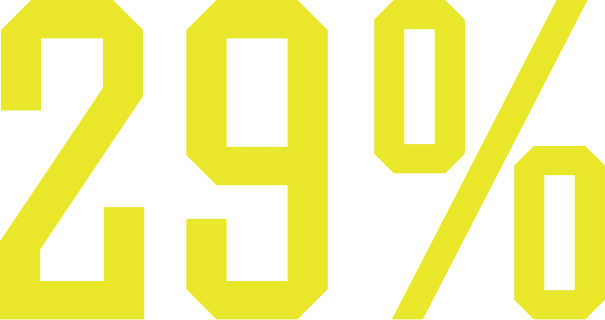
- Triple Whammy 27% faced all three workforce risks simultaneously: a thin or skill-gapped workforce, critical knowledge nearing retirement and no succession plan.
When is the right time to invest in technology?
Technology Delivers the Greatest Value Only When the Foundation Is Ready
Maintenance organizations aren't hesitating to invest in technology. In fact, the research indicates many are making those investments before they're operationally ready. The research found that 76% of organizations had already invested in maintenance systems.
And that’s the rub: while technology can improve visibility, streamline workflows and support better decision-making, it can't replace the maintenance fundamentals that drive long-term performance. Technology works best when it's reinforcing strong maintenance practices, not compensating for gaps in them.
New systems and training programs often feel like progress because they’re a tangible representation of investment. And they can be, but only when introduced in the right sequence. Otherwise, organizations risk adding complexity while the underlying problems remain unchanged.
Technology Readiness
The research doesn't suggest organizations are investing too little in technology. It suggests the majority of them are investing too soon.
Tech Ready
Only 38% had the operational foundation needed to fully support maintenance technology investments.
Not Fully Ready
62% were missing one or more foundational elements needed to maximize the value of maintenance technology.
Invested Before Ready
76% have already invested in maintenance systems… and aren’t fully ready for them.
How can you gain the organizational support needed to drive lasting change?
"Decisions used to go to whoever argued loudest. I started bringing data instead. That changed the conversation — but you can't bring data you don't have."
– Survey respondent, Plant Manager
Better Data Builds Stronger Business Cases
Most maintenance leaders don't struggle to identify what needs to improve. The harder challenge is building organizational support to do something about it.
Maintenance improvements compete with many other business priorities, and visible solutions often receive the most attention. New technology, training initiatives and organizational partnerships can all represent worthwhile investments — but only when they're introduced at the right time and supported by the right operational foundation.
The organizations that gain support are the ones that can clearly demonstrate not only what they want to invest in, but why it's the next logical step based on measurable performance data. Use the findings in this report as a benchmark to help frame conversations with leadership and demonstrate why change is needed.
Build Your Business Case
As you compare your organization against the research, these questions can help identify where to focus improvement efforts and how to frame the conversation with leadership
- What problem are we trying to solve?
- What's it costing us today?
- What's the next improvement that will have the biggest impact?
- Do we have the data to prove it?
How do you measure meaningful progress?
Measure Progress, Not Just Activity
Maintenance improvement doesn't happen because a new process is introduced or a new system is implemented. It happens when organizations consistently measure whether those changes are producing better results.
The research found that 40% of organizations couldn't confidently determine whether their maintenance programs were improving. Without that visibility, it's difficult to know whether an investment is paying off, whether priorities should change or whether it's time to move on to the next improvement.
The organizations that made the greatest progress weren't doing fundamentally different work. They were measuring the impact of each improvement before taking the next step. That discipline made it easier to prioritize investments, build organizational support and continue improving over time.
Use the findings in this report as a benchmark for your own maintenance program. As you implement improvements, return to the seven questions to measure progress, validate what's working and identify where to focus next.
Measure What Matters
Improvement is easier to sustain when progress is measured consistently. As you put the findings in this report into practice, check in regularly by asking:
- Are we solving the same problems we identified six months ago?
- Where have we made measurable progress?
- Which metrics tell us we're moving in the right direction?
- What's the next improvement we should prioritize?
How can you prepare your maintenance organization for the future?
Preparing for the Future Starts With a Strong Foundation
Preparing for the future doesn't always mean investing in something new. More often, it means building on the work that's already underway and making sure the fundamentals are strong enough to support whatever comes next.
Only 36% of the organizations in this study met the threshold across all three foundational areas. Those organizations consistently outperformed the rest of the sample not because they were doing more, but because they had the discipline to consistently do the right things first.
The research points to a clear pattern: organizations that make the greatest long-term progress don't try to solve every challenge at once. They strengthen one area and build on that success with each following decision.
The next step is understanding where your own organization stands. Use the findings in this report to identify your biggest opportunities, then take the Maturity Model Self-Assessment to compare your organization against the same framework used throughout this report.
How Organizations Stack UP
All other trademarks are owned by their respective companies.